Category Archives: technology

Tron: Legacy — soundtrack

Being a geek of a certain age, I of course went out to see Tron: Legacy as soon as it opened in the theaters. And being a geek of a certain type, and having listened to Wendy Carlos‘ ethereal soundtrack to the original Tron, I also purchased the soundtrack to this one as soon as it was available. This was my first introduction to Daft Punk, whom (I must admit) I first even heard of when their role was announced to much rejoicing. On receipt of the CD (yes, I still buy physical goods from time to time), I learned that they had worked on the orchestration with Hans Zimmer, a composer whose other cinematic work I do know and enjoy.

I say all this to make clear that I cannot evaluate the album as to its “Daft Punkness”. On my first listen through, I was underwhelmed. Wendy Carlos notwithstanding, I am not much of a fan of techno, and this album is certainly that. But having spent the cash I gave it a few good listens, and then I noticed that I was replaying the music in my head throughout the day. That’s just about the best recommendation you can give an album: it’s something you want to keep listening to. It evokes the movie (which I very much enjoyed) without being dogmatically tied to it. I’ve played these tracks for more than anything I’ve purchased in the past year or so.

Continue reading

I like programmers with a sense of humor…

dropbox is one of my favorite “cloud” utilities.  It keeps a directory synchronized across many computers, allowing remote access and automatic backup.  Whenever you set up dropbox on a new computer, all of the files need to be copied across.  As you might imagine, this can take some time.  Usually, dropbox pops up a little balloon telling you how many files are left and about how long it will take.  But if you are syncing a huge amount of data…

… well, you get the message below.

:)

Metatropolis

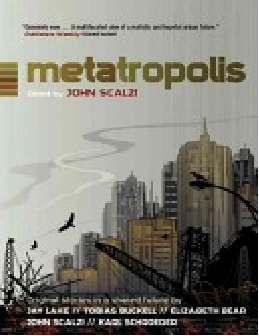
Review: Metatropolis

Metatropolis
Edited by Jack Scalzi
Rating on an arbitrary 5-point scale: 4 out of 5

Metatropolis is a science fiction anthology exploring, as it claims, the “future of cities”.  That’s not strictly accurate. It’s really a collection of stories that explore the question: If we as a species are going to survive the mistakes of our forebears (particularly ecological mistakes), what will human society have to look like?  It’s pretty clear that we won’t be able to ratchet up world living standards to the stereotypical 2.4 kids in the suburbs mid American ideal.  Resources are too finite and indeed running out.  If our profligate carbon society doesn’t right itself soon, if we face a Century of Judgment, then what will emerge from the drowned coasts and droughted interiors?

The five authors (Jack Scalzi, Jay Lake, Tobias Buckell, Elizabeth Bear, and Karl Schroeder) don’t really offer blueprints and white papers, of course.  They off five distinct tales, appropriately interdependent, that explore a possible future.  This is a shared world on the model of Aspirin’s Thieves’ World, though not quite so sprawling or tightly woven.  It is clear that the authors spent considerable time together thrashing out their shared world — though, in keeping with the theme, much of that might have been online and virtual.

So, does the book succeed?

Continue reading

Why I have no respect for design behaviors at Microsoft

I’ve received my new laptop and am working on getting it outfitted and up to speed.  (This process, by the way, is distressingly like moving to a new home and is equally as frustrating and potentially as traumatizing.)  After logging in for the first time, the system helpfully suggests that you create a system backup.  This is a wise and useful thing to do, so that you can restore to original conditions, and I was impressed that Microsoft offered it.

Except…

It takes fiendishly long to generate the system image — after about two hours of waiting, I gave up last night and went to bed.  During the night, the other “helpful” feature of Windows 7 kicked in, which was automatic downloading and installation of updates.  As anyone who works with Microsoft knows, you can’t even think about an update without Windows needing to reboot, which it did … automatically.  This interrupted the system backup, of course; and since the system has changed, the backup can’t even just pick up from where it left off.

Net result?  I must begin the backup again and wait another two hours for it to run.   I will have had my laptop for over a day without being able to run a single program on it.  What is the overwhelming temptation, of course?  To skip the backup “for now” and just dive in.  So these two choices for Microsoft have the combined effect of discouraging proper computer hygiene — and for many users, probably taint the whole idea of backups in general.

Way to go, Microsoft!

(By the way, I have of course also now turned off the automatic install option, as it’s insane to let anyone just drop stuff into your operating system without at least some chance at review.  Once again I am reminded of a mantra I’ve had since at least Windows 95:  Whatever default behavior Microsoft settles on, it’s the wrong one.  We could call their philosophy “default-to-fail”.)

Ethics and Economics in Journalism

Via Ezra Klein, a wll-argued piece by Timothy Lee on the recent flap over the forced resignation of Dave Weigel from The Washington Post.  If none of those names mean anything to you, then this is unlikely to be very interesting…  Lee’s thesis is that reportorial objectivity is more a function of the economies of scale of a major newspaper than any unquestionable principle of High Journalism.  And now that the economics of reporting have shifted, so too must our understanding of what is appropriate.

And yes, I didn’t link to the Post because I happen to think they’re wrong on this one and I’m just petty enough to deny them the infinitesimal traffic I might contribute.

Facebook’s vanishing privacy

The EFF has an excellent timeline of the changes in the privacy policy at Facebook.  It’s worth a read for anyone who might consider Facebook either (a) private in any sense or (b) ethically reliable in any sense.  These changes bother me less than other people because I’ve always assumed Facebook would screw us over on privacy, so I treat it like a big virtual billboard+skywriting.

The rising threat to music of the home taping phenomenon

This video (http://www.youtube.com/watch?v=R3jkUhG68wY&feature=player_embedded) is a hilarious take-down of the music publishing industry’s allegation that personal filesharing is “killing” music.  Part of the fun is figuring out the early 1980s references.  Also, I would totally buy a flag that had that cassette-and-crossbones logo…

Also, remember that according to former MPAA chief Jack Valenti,

[T]he VCR is to the American film producer and the American public as the Boston strangler is to the woman home alone.

Not that the content cartels would ever condone the use of overblown and hyperbolic language to frighten lawmakers into writing into law special rights to protect their outmoded business models…

Knowing is Half the Battle

I was cruising TechDirt and saw a neat post on “Is The Federal Government The Most Interesting Tech Startup For 2009?“  The idea is that the recent data.gov initiative has led to an outpouring of with-it and effective apps allowing anyone to get a handle on the vast trove of information compiled by the federal government.  If you haven’t checked out data.gov, give it a whirl — it’s pretty astounding.  After a week of hearing about ludicrous claims of “death panels” and “keeping government’s hands off my (government-run) Medicare”, it was nice to be reminded that good people working hard can produce tremendous work — that government can serve a positive purpose and isn’t intrinsically evil, corrupt, or incompetence.

Some of the nifty apps I saw (via the techdirt link) were

This isn’t quite the level of Star Trek (“Computer, rearrange known data into a new theory of physics”) but it’s a step in the right direction.  :)   And if the survival of democracy requires the active participation of an educated and engaged citizenry, then cataloging what is actually known can help secure the health of our republic.  For all the noise and thunder of the 24-hour news cycle, this is where the action really is.