Category Archives: American cantos

This is important: What we know about what happened in Boston

Nothing.

We know nothing of import yet, and won’t for several hours, if not an entire day. That is the way of these things, and the truth of them.

Nonetheless, the circus has begun. Each network has already offered its own (or its several own) opinions on who caused the bombing, who planted the bombs, and why. They’ve thrown up experts onto the screen, some with actual expertise but none with actual knowledge. How do I know? Because anyone who does actually know something is busy right now, with, you know, the investigating and the saving lives and stuff.  People who know are too busy contributing for them to waste time satisfying our ghoulish need for details.

The terror of actions like this, for me, does not lie in the risks we face or the suddenly-heightened sense of my own mortality.  The terror lies in the amazing speed with which this sort of event divides us, inflames us, sets us against each other.  It did not take long for World Net Daily to come up with its list of suspect ideologies to be blamed.  It didn’t take long for CNN.  It didn’t take long for me — and that’s what scares me.  I have to keep reminding myself that we don’t know anything.  We don’t know if this is the work of a terrorist group (foreign or domestic), or a lone madman, or someone with a grudge or a defective sense of grandeur or an aching consuming need to grab our attention.

It is so easy to take such an event and slot it into our comfortable pre-existing narratives. We spend our time imagining the worst of our opponents, so when the awful happens, we say “I can see how [group X] might be behind this sort of thing”, and then we seamlessly convince ourselves that they are behind it, and eventually we forget that we’re just speculating.

There is a nebulous, magical radius around the site of a catastrophe.  Within that distance, we find the extraordinary ordinary people, the ones who run into fire and smoke and fear, who reach across the yawning divide and yank people back, the ones who won’t give up and won’t let go and who unthinkingly do the right thing.  But beyond that special radius, it seems we fall prey to the worse angels of our nature: We accuse and tar and disdain; we assume the worst; we fall upon each other in anger and accusation.

So, tonight, let us remember this:  We don’t know anything yet.  The who and the how and the why will come out, will be known, will be important, but not tonight.  We don’t know anything tonight.  How this happened and how it could have been avoided and how it might happen again — these are questions of weight, but not right now.  We don’t know anything — except that some have died, many are injured, and many more are grieving.

Tonight, that is our truth.

[Note: This post has been edited for spelling and grammar.]

Published in the Hun Review

This is just a list of things I’ve managed to get published in the Hun Review, my school’s literary annual:

Blaze

A thrill runs through them –
swarming in the darkness cast by the night sky –
as a man steps to the microphone
And harangues..
A moment before they were a hundred lives
with a thousand cares
milling about in momentary association.
A moment later they are a seething oneness
with two hundred eyes
but a single vision that is somehow
still blinded.

It takes just a moment,
the tiniest sliver of time,
no longer than a spark takes
to ignite a blaze.
With it they blaze,
their murmurs become chants,
their chants become roars,
their roars become silence
of the most thunderous kind
full of intent
empty of craft
finding meaning in their meaningless
taking shape in their formlessness.

Through it all their leader
provides their words
massages their emotions.
validates their prejudices
In charge but not in control
he is just another expression
another organ
of the dark spirit animating their shouts
which fears the light
but revels in the fire
and loves to see it consume.

A will emerges in the crowd
Not the will of the leader
or of the people
or of any person
but the Will of generations
of a hungry jealous impulse
born of starving days,
of freezing nights,
of countless unformed terrors
of millennia of slights real or projected
of infinite loves offered and rejected
of all the individual scars borne in common
with their parents and their parents’ parents
and even unto the first generation.

This Will emerges from the crowd
diffusing from their pores,
their mouths, their eyes,
and looks upon the fire that blazes still
the center of attention yet curiously
unheeded.
The Will looks upon the leader
calling out the slogans
stoking the crowd.
The Will looks upon the crowd
Feeding the leader with their adulation
Feeding the fire with their anger and fear
Feeding the darkness with their tainted light
The Will looks upon this
small patch of world
and deciding it is good
returns Itself to slumber
knowing Its time has not yet come

But it will

again.

From Arizona to Missouri

In the summer of 2007, I had an epiphany. It was about, of all things, Rock, Paper, Scissors. Rock, Paper, Scissors is a non-transitive method of decision between two people, wherein each secretly picks one of the items and they compare. The key bit is that each item ties with itself, loses to one item, and beats the other. The traditional phrasing is, “Rock blunts scissors; scissors cut paper; paper covers rock”. It’s that last one I want to focus on. Paper covers rock? What the heck does that mean? How is that a win? Truth be told, it’s bothered me for literally decades; but I’ve finally come to an understanding I can accept.

In 2007, I had the opportunity to visit the national Pearl Harbor Memorial in Honolulu, Hawai’i. Commemorating a naval attack, it is fittingly primarily a naval monument. The two great anchors of the monument are the USS Arizona and the USS Missouri. The Arizona was a battleship sunk during the Pearl Harbor attacks. Though most of the Pacific Fleet was refloated and rebuilt in the years following the attack, the Arizona could not be salvaged or moved. It sits at the bottom of what was once Battleship Row. The Navy operates a tender from shore to the stark elegant observation station that has been constructed above the wreck. From it you can look down on the coral-encrusted hulk of the Arizona, watery tomb for the majority of the servicemen killed that day.

The Missouri was BB-63, the last battleship ever constructed by the United States. Now a museum ship docked at Pearl Harbor, the Missouri is still an intimidating sight. Towering over the shoreline, she bears three turrets each with three 16-inch guns capable of throwing an explosive shell a distance of 20 miles and landing within a circle of radius six inches. The Missouri was a great and terrible engine of war, and everything in her design speaks to the awesome destructive powers that could be marshaled by an enraged industrial democracy. But standing on her deck, I found the most stirring and moving part was not her giant main guns, nor the anti-aircraft machine guns still deployed on the side, nor even the capped tubes wherein Tomahawk cruise missiles had been installed in the 1980s. It wasn’t the sweeping bow or the grim turrets or the majestic bridge. It was a simple golden circle fixed to an otherwise nondescript spot on the mid-decks.

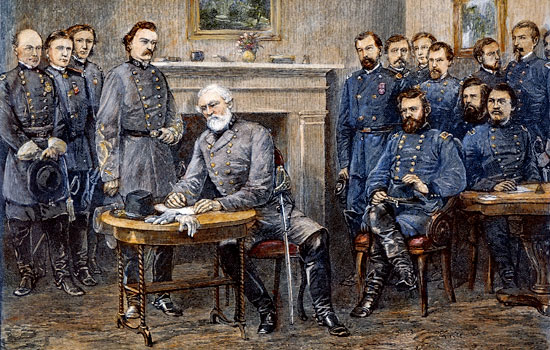
In September 1945, at that spot on the decks of the Missouri, in the waters of Tokyo Bay, representatives of the Empire of Japan signed the formal documents indicating their surrender to the forces of the United Nations, ending the Second World War. In a brisk twenty-three minute ceremony, a band of perhaps twenty men — Japanese, American, Canadian, British, and Russian — affixed their names to two copies of the surrender documents to enact the armistice. From that point on the Missouri, you can just see the alabaster arc of the Arizona memorial. Between Arizona and Missouri lie a few hundred yards of open water and a few hundred thousand American casualties. They bookend the American involvement in a war that spanned a decade and a half and claimed upwards of sixty million victims — a number that, even living at the dawn of the most dangerous century, must give us pause.

Standing on the Missouri in mid August, I overhead a museum guide relate a story that struck me immediately. It’s one of those little tales that museum guides love, a tidbit that uses the mundane to illuminate the immense. Signing the Japanese surrender document was, as you might imagine, an event of great import in anyone’s life and, as you might also imagine, it could be the source of great trepidation. The representative of Canada, L. Moore Cosgrave, was apparently overcome by his nervousness and, while signing the Japanese copy, signed on the line for the French Republic. This forced everyone following him to also sign on the wrong lines. Eventually, concern over the implications of this error lead General Richard Sutherland to cross out the names of the nations and pencil in the correct ones.

It was a minor, totally banal detail. Yet it was also a striking, astonishing thing. At that moment, General MacArthur stood in supreme command of the largest, most powerful military forces in the history of the world. Having brought the Empire of Japan to its knees, the Allied Powers held uncontested dominion over East Asia and the Pacific. How truly bizarre was General Sutherland’s consternation – between them, these men standing on the deck of the Missouri had fought the most devastating war ever known, had overseen barbarities of a nature hard to contemplate, had rained down obliteration on entire cities and had sent millions of men to their deaths to do it. Yet here they were, worried that somehow, a signature in the wrong place could render the document worthless and the exercise moot — that somehow, a misplaced name could unmake the surrender.

And that’s the hidden key. The Missouri, the last and greatest battleship, the apex of naval construction, serves as a very present icon of physical force — standing at the head of an unbroken lineage stretching all the way back to the first rock lifted by a semi-evolved ape in assault upon its brethren. Our long and bloody history attests to the power of that rock. But on that day in Tokyo Bay, it was not the battleship that mattered, or the airplanes or submarines, or even the atomic bombs looming in the background. To the assembled warriors of the most terrible conflict, what mattered was the document. Paper trumps rock.

And isn’t that the way, when you think about it? We often mistake the things as the drivers of history: wheat and salt, gold and oil. But somehow it’s the pieces of paper that seem to truly matter, to truly steer the course of human life. In 1914, a relatively minor Balkan War was transformed into the First World War by German violations of Belgian neutrality, codified in the Treaty of London of 1839. Informed that the British would go to war to defend Belgium’s neutral status, German Chancellor von Bethmann Hollweg expressed his shock that they would expand the war over what he infamously dismissed as a “scrap of paper”. That scrap of paper shook the foundations of Europe and remade the world order. Its spiritual successor, the Treaty of Versailles, would help engender the next world war.

The Declaration of Independence. The Constitution of the United States. The Magna Carta and the Declaration of the Rights of Man. The Emancipation Proclamation. The Fourteen Points and the Atlantic Charter — mere words on a page, just scraps of paper. But nothing more feared by tyrants, more despised by despots. It was no accident that the Soviets registered every typewriter and decreed unauthorized use of a photocopier to be a felony offense, punishable by jail time or even internal exile. They knew in their bones that they faced a greater existential threat from little scratches in black and white than from all the nuclear missiles in the world.

In a very real sense, the most disruptive weapon ever invented has been the printing press.

And there, under glass, on the gently rolling deck of the mightiest warship ever constructed, was a piece of paper that had ended a war merely because it said so. The history of the war was written in the blood of its combatants – but it was ended through ink. The document contains little in the way of soaring oratory or grand pronouncements. It is a legal thing, a dry thing, a weary thing yet resplendent. That piece of paper recognized a changed reality and so created it.

Words on a page. Scraps of paper. They give form and life to the ideas they contain. Through them we transcend the oral and enter the eternal.

Paper trumps rock — may it ever be so.

The Memory of Pain

Awhile back, I had a toothache.

I don’t mean a sort of ache-in-the-gums, vague, “oh, I’d better brush more regularly” toothache. I am talking about a full-blown nuclear meltdown in my teeth. Throughout my life I have been blessed with pretty strong teeth but now the evil forces of dental decay had their vengeance. It caught me entirely by surprise and totally unequipped to deal with the sudden implacable demands made upon me by my screaming nervous system. For more than a week, the rest of my life receded to the periphery of my cognition and I became absorbed with finding any relief whatsoever. I learned, too late and to my regret, that in matters of dental hygiene, the wages of laziness is agony.

But my agony, per se, is not what I want to write about. During this ordeal I suffered through every shade and flavor of physical pain I can imagine. At times the toothache was a dull pressure in my jaw. Other times, without warning, a spike of pain would impale me, a localized burst of misery shrinking my world down to one malfunctioning molar. There were even occasions when my ears hurt, a smooth sine wave of suffering slowly sidling from the socket of my tooth along my jaw, into my inner ear, and back. Sometimes I suffered stoically; sometimes, lights went off behind my eyes and I jumped into motion unable to bear sitting still with my pain.

There were respites. A steady stream of cold water provided fleeting but effective relief. Zinc tablets helped, apparently by poisoning the nerve or some other awful thing. A fourfold dosage of Motrin came to my rescue on multiple occasions. In the end, exhaustion itself served as a palliative. Through it all, the toothache remained – sometimes chained off in a dark corner of my mind, like a long-forgotten nightmare, but omnipresent and always trying to claw its way back into the light. I was aware of it, every texture and hue of misery, and it was aware of me. I might achieve a standoff but I knew we would keep wrestling.

That’s when I became conscious of something which I suppose I’d known but which I’d never really comprehended: The human mind cannot remember pain. We can remember the fact of pain but we (or at least I) don’t re-experience the actual sensation. This is quite different from other memories. At this moment I can cast my mind back to a concert and relive Marc Cohn leading an audience in a Gospel rendition of “Walking in Memphis”. I can feel the sunlight on my face and I can feel the excitement as I walked onto the field at Stanford Stadium to receive my degree. I can still taste the cake from the wedding of my best and oldest friend. But for the life of me I cannot recall, cannot reconstruct, cannot relive the pain of this world-shattering toothache, from a bare month ago. Even during the toothache, during those moments I was pain-free, I was conscious only of the fact of my toothache and the likelihood of its return.

I’m not complaining, of course. Pain is not the sort of thing one asks for in life. Once done with, it is happiest consigned to the past. But I still find it curious. I don’t particularly want to relive my car accident from December but I can. There’s a moment where things moved too quickly for me to comprehend, and so I do not remember anything but a blur. But my memories of pain are different. They’re not missing, exactly. It’s more like they’ve been covered by clear plastic, visible but not touchable – the difference, I suppose, between a window and a picture. Although I know that I experienced such moments, they still seem to belong to someone else. Stability and equanimity are gained by severing the connection, but something, too, is lost.

When I was twelve going on thirteen, on one ordinary June day, my father committed suicide. It happened out of the blue – my father was never moody or depressed, at least to the eyes of a twelve-year-old – and it sundered my world. I have the distinct memory of the fact of vertigo, the sudden sensation that the floor had been pulled out from under me. I can remember that I received the news at the screen door near the kitchen in the house that, up until this point, we lived. I remember clearly that I had just opened the first issue of a new magazine devoted to the then-hippest computer, a Commodore 64, and I can even recall a flash of irritation at being called away from my current article over to the kitchen door, where I was told my father was dead.

I can’t remember who told me, though, and I can’t remember what they said. My next memory is of lying sprawled face-down on our old couch, on the other side of the house, keening a wordless cry. And now, more than two and a half decades later, I might recall that moment – and I feel sympathy for that almost-teenage boy – but I cannot bring the feeling back. Without quite intending to, I have lacquered over that bit of my life mosaic. It took four years, and several intense sessions with a counselor, for me to even admit to myself that I had painted it over. I now know I felt these things, but I cannot now feel them again, not even in echoes.

I’m not sure how I feel about that. I don’t particularly want to experience pain, but once I have, I don’t want to have wasted the effort.

Takings and Leavings

Let’s just take a moment
Take stock of where we stand.
I could take you all the way
If you’d just take my hand.

I can take direction
When your writing’s on the wall
I will always take your side
But I won’t take the fall.

When you leave me, you still take me by surprise.
When you take off, you leave me holding just tears and lies.
When you take flight, I’m left lying on the ground
But when you leave me, I won’t take it lying down.

Leave us an escape route
Leave yourself some breathing space
Leave a trail of breadcrumbs
If you must leave this place.

Leave off from your crying
Leave your sorrow far behind
Leave the past in the past
Let the ghosts leave your mind.

When you leave me, you still take me by surprise.
When you take off, you leave me holding just tears and lies.
When you take flight, I’m left lying on the ground
But when you leave me, I won’t take it lying down.

Meaning Between Extremes

The fact I walk in darkness
Doesn’t mean I love the night
And the fact I didn’t see it
Doesn’t mean I’ve lost my sight.
The fact I won’t surrender
Doesn’t mean I want to fight.
And the fact it all went wrong,
Doesn’t mean it wasn’t right.

The fact I never said I love you
Doesn’t mean I didn’t care.
And the fact you never judged me
Doesn’t mean that you were fair.
The fact I never touched you
Doesn’t mean I wouldn’t dare
And the fact I had to leave you
Doesn’t mean I won’t be there.

You only spoke in Love and Hate, you dealt in Black and White
And you knew that something must be Wrong if you couldn’t prove it Right.
You found certainty in simplicity, and meaning in extremes,
And I was just another thing misplaced among your dreams.

The fact our feet were off the ground
Doesn’t mean we ever flew
And the fact you held all the cards
Doesn’t mean you ever knew.
The fact you never spoke a lie
Doesn’t mean that you were true
And the fact you chose to say good-bye
Doesn’t mean I said it too.

A Tide Between

Two bodies whirl past each other,
reaching across the void
tugging at each other’s centers
pulling each other into a dance
they circle a common center

If things were simple, if they were simple
The dance would be eternal
A balance between come-hither
And keep away
That turns attraction to stability.

But they are not simple, point-like and pristine
For each, the center is an abstraction
A hypothetical about which they
have become arranged
And so things are not simple.

Some parts are nearer together
and yearn to be nearer still
Other parts are moving too fast for comfort
and desire more space between

There is a tide between them
A differential attraction that
Kneads their very cores
Generating stress and heat
Reshaping their depths and
The faces they show outside.

The force pulling them together
Also tears each one apart

The King Lies Dying

The King lies dying. Night after night, awake in his bed at an unholy hour, he feels his life leaking out of his body, gathering in limp black pools in the pits of his history, like the sweat that congeals between his back and the bedsheets. Unseen above him the stars stagger ’round the sky in their eternal intermiable whirl and he can feel their funereal procession ticking off the dwindling moments until the Sun rises and wearily cuts one more futile notch in the log of his days.

The King lies dying. He can feel it in his bones, has felt it for many months now, though all his counselors and privvy lords assure him he has never looked more the picture of health, the very paragon of vitality. He listens and nods at matters of state but his arms hang leadenly at his sides and the crown, he knows beyond faith, would — given a moment’s chance — snap his neck should he let it dip down at all. It is all he can do, each day, to rise and sit and stand and shuffle wearily through the rooms of his court, until he can find a moment’s grace in simply sinking wearily into his fresh-turned linen sheets, where he listens to the stars spin their nightly waltz that would be a mockery of him, if he were in their thoughts at all.

How did it come to this? He can still hear the echo of the triumphal horns trumpeting his entry to the city, the cheering multitudes lining his path with roses. He can still remember being hailed as a hero, greeted as a gentle conqueror. He can still taste on his tongue the heady wine that flowed, buoying his visions of the bright future. Life had been hard in the land of that time, it was true, but now his steadying hand would still the rudder and carry them all safe through the raging storm. Times would be good again.

How did it come to this? Times had been good, he had made them so, and the land had prospered under his hand. From the cruelest depths he had led them to undreamt heights, from darkest night into the bright sunlight. He had strode magnificently at the head. Now he could barely shuffle from one room to the next. He suffered and the land suffered. He could no longer distinguish between his anguish and its, no longer tell whether his illness caused the land’s distress, or it his. They were one and the same, a long drawn-out sigh of weariness and regret.

He faces the end alone. Oh, even now he is thronged by courtiers and supplicants, transparent well-wishers who drink his health but savor his deterioration. Some have been with him since the earlier, brighter days, from even before his exile and miraculous return. They watch him decay now and in their eyes he sees — he hopes he sees — sorrow and pity, flickering remembrances of greater times. Others of his lords he inherited upon his return. Though they have served him mostly well, always there has been the thread of anger. Displaced by his ascendancy, they watch now with a barely-buried glint of glee, impatiently waiting for the conclusion of his long long fall. Finally in his court are those he has drawn there himself, attracted from abroad, raised up from the commonhood — some, even, the now-grown children who had paved his path with petals.

He faces the end alone. Everyone does, he supposes. But not everyone dies alone suffocated by a cloud of courtiers bearing false concern, false hope, false faith. The coterie surrounds him at every lit moment, none wanting to be with him as the end comes, none daring to be away when it does. Though they do not ken it, he sees them sharpening their knives — not for him, hardly worth the effort in his decline, but for each other. He is going, and when he is gone the storm will break over the land more fiercely than ever. Yet all secretly, in their hearts, wish him over and gone soonest, now, even himself.

He has carried them so far and can no further. He breathes heavily and knows that it is time to give up breath, to exhale his spirit where it can mingle with stones and brook and history, to be buried and become one again with the land and so begin to heal it. His sun has set and another must arise, to usher in a new dawn and a new hope — the light of a day his eyes cannot see. He knows this.

He has carried them so far and can no further. Yet he seems at the last unready to lay down the burden. He draws breath and knows that he cannot yet cease, that a lifetime of doing has rendered him unable to halt. Some part of him still clings to the world. He wishes it were otherwise, prays so even, but in the deepest part of his heart — the same part that knows it is time — he knows he cannot let go, not yet. He will hang here a while more, caught between the dusk and the dawn, and the land hangs with him, suspended awaiting a rebirth of possibilities, after the death of hope.

The King lies dying.